Build your career resilience

How would you deal with career disruption? How resilient would you be to a change of direction? The author of this article proposes six steps for building your career resilience. These steps will help you deal with any unplanned career changes, whether that’s being laid off or experiencing a major life event which affects your career choices.

Be adaptable

Being open to change is important for career success. Some behaviours that help develop an open mindset include proactively learning new skills, believing in your ability to succeed and taking risks.

Use and apply your skills

After attending training, do you typically forget the new skills when you return to the workplace, or do you try to put the new skills you’ve learnt into practice? It takes grit to continuously practice and hone new skills to achieve a goal. The author cites work by Angela Duckworth, a Harvard University researcher who has identified ‘grit’ as one of the key traits that predicts success in life.

Build a strong network

The author points out that starting to build relationships when you’re unemployed is too late. She references a 2001 report by Monica Higgins and Kathy Kram who found a strong network needs quality and diversity. Quality is not just about building relationships with influential people; it’s also how good these relationship are. Diversity means having a wide-ranging network of people at different organisation levels and from different sectors to provide alternative perspectives. The author makes the point that networking isn’t just about adding connections on LinkedIn, but it’s about meaningful relationships where you also contribute ideas and provide support.

Maintain your health and balance

Looking after your own well-being during any major life transition or event needs to be your priority. You need to take time to rebuild your strength and your buoyancy. Changes can be unexpected and may be a result of a family event affecting your professional life. Don’t underestimate the need to focus on your health and the importance of addressing any negative self-talk.

Follow your instincts

The resilience literature highlights the importance of self-efficacy and self-perception to a person’s career success and their willingness to try new things. What does your instinct tell you is the right avenue for you at the current time and where you want to be in the future?

Control yourself

Angela Duckworth identified self-control as another predictor of success in life, alongside grit. Being able to regulate your behavioural and emotional impulses is vital, but needs to be paired with a determination to succeed in what you do. Overall, to be career resilient, we need to have self-discipline, take opportunities to develop, be mindful of the need to be adaptable, build a strong network and believe in our ability to weather the times when we get blown off course.

Poster Resource: Brew Monday 2026

16.01.2026

Poster Resource: Brew Monday 2026
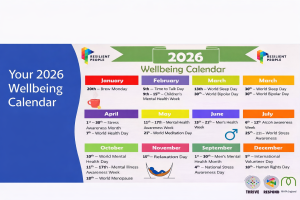
2026 Workplace Wellbeing Calendar: Using Awareness Days to Build Healthier, More Supportive Teams

13.01.2026

2026 Workplace Wellbeing Calendar: Using Awareness Days to Build Healthier, More Supportive Teams

Boosting Winter Mindset at Work: Practical Tools for Colder Days

05.12.2025

Boosting Winter Mindset at Work: Practical Tools for Colder Days

Mindfulness

Mindfulness is a way of paying attention to the present moment, using techniques like meditation, breathing and yoga. It helps us become more aware of our thoughts and feelings so that instead of being overwhelmed by them, we are able to manage them better.

The focus on mindfulness in business has grown exponentially as organisations recognise that rapid changes in technology, the marketplace and the global playing field have caused chaos and uncertainty. These realities create stressful conditions for the people within the organisations and thus calls for a change.

Practising mindfulness can give people more insight into their emotions, boost their attention and concentration and improve relationships. It’s proven to help with stress, anxiety, depression and addictive behaviours, and can even have a positive effect on physical problems like hypertension, heart disease and chronic pain.

How you can be mindful

Reminding yourself to take notice of your thoughts, feelings, body sensations and the world around you is the first step to mindfulness.

As we go about our daily lives we can almost sometimes go into an ‘autopilot’ mode which causes us to block out all kinds of things that are going off around us, everyday things like the food we have, the sound of the birds singing or even just the feel of the breeze moving around us. Taking the time to notice these seemly small observations can have a huge impact and knock us out of autopilot and give us a new perspective on life.

It can be helpful to pick a time – the morning journey to work or a walk at lunchtime – during which you decide to be aware of the sensations created by the world around you. Trying new things, such as sitting in a different seat in meetings or going somewhere new for lunch, can also help you notice the world in a new way.

Also, take notice of all the different things that goes off in your mind. Take a step back and watch them go round in your head, imagine they’re like leaves swirling round on the ground when it’s windy. There is no need to try to change the thoughts, or argue with them, or judge them: just observe. This takes practice. It’s about putting the mind in a different mode, in which we see each thought as simply another mental event and not an objective reality that has control over us.

You can practise this anywhere, but it can be especially helpful to take a mindful approach if you realise that, for several minutes, you have been “trapped” in reliving past problems or “pre-living” future worries.

As well as practising mindfulness in daily life, it can be helpful to set aside time for a more formal mindfulness practice.

There are several practices that can help create a new awareness of body sensations, thoughts and feelings. The most commonly known are:

  • Meditation – where participants sit silently and pay attention to the sensations of breathing or other regions of the body, bringing the attention back whenever the mind wanders.
  • Yoga – where participants often move through a series of postures that stretch and flex the body, with emphasis on awareness of the breath.
  • Tai-chi – where participants perform a series of slow movements, with emphasis on awareness of breathing.
Poster Resource: Brew Monday 2026

16.01.2026

Poster Resource: Brew Monday 2026

2026 Workplace Wellbeing Calendar: Using Awareness Days to Build Healthier, More Supportive Teams

13.01.2026

2026 Workplace Wellbeing Calendar: Using Awareness Days to Build Healthier, More Supportive Teams

Boosting Winter Mindset at Work: Practical Tools for Colder Days

05.12.2025

Boosting Winter Mindset at Work: Practical Tools for Colder Days

Wanting a happier outlook?

It’s easy to focus on all the negatives in life, in fact it’s what we are programmed to do. It’s part of our drive for self-preservation. It helps us to identify and avoid situations that maybe undesirable or dangerous. The problem however is that constantly focusing on things we perceive to be negative eventually leads to a pretty miserable existence.

One of my favourite exercises for creating a more positive outlook and happier disposition is using a gratitude list. It’s simple, takes little time and can really change how you view the world around you in a matter of weeks.

To start you just need to set aside 5-10 minutes each day. This can be whilst you are driving to work, standing in a queue, cooking a meal or any other time you can have 5 minutes of uninterrupted thought. For me it’s whilst walking my dog. During this time consider all the things you are grateful for in your life. I tend to group things to make it easier. I start at a high level i.e. being alive and being born a country where all my basic needs (food, water, shelter, healthcare and social security etc.) are all met with little effort on my part. If I’d been born in one of the world’s many slums then these needs would either be a daily struggle or distant dream.

My list then moves closer to home. I consider my personal health, abilities and general attributes before moving on to my family and friends; all the many ways they support me and bring joy into my life. And lastly I appreciate all the material things I have in my life. This last bit is important because although material possessions don’t usually bring long-term happiness, by regularly appreciating what you have you curtail the desire to have more. You will start to enjoy the things you already have and fret less about the things you don’t.

There are many ways of appreciating the things on your list and this is something personal to your own beliefs i.e. thanking god. For me, I just think the words ‘I really appreciate …’ before saying the thing I’m grateful for. With a bit of practice you’ll be amazed how long your list becomes and in 3-4 weeks (perhaps less) you’ll be surprised how much more happier and content you feel.

Enjoy …

Barrie

Poster Resource: Brew Monday 2026

16.01.2026

Poster Resource: Brew Monday 2026

2026 Workplace Wellbeing Calendar: Using Awareness Days to Build Healthier, More Supportive Teams

13.01.2026

2026 Workplace Wellbeing Calendar: Using Awareness Days to Build Healthier, More Supportive Teams

Boosting Winter Mindset at Work: Practical Tools for Colder Days

05.12.2025

Boosting Winter Mindset at Work: Practical Tools for Colder Days

The 3 minute re-frame

How you feel at any given time depends largely on what you are thinking about at that moment. Dwelling on a negative experience will cause you to relive the moment over and over again. Similarly, thinking of positive experiences will lift your mood. The 3 minute reframe is about putting you in the right frame of mind for the task ahead. Here is an example of a typical situation for many of us:

You arrive home after a bad day at work, but before entering the house you sit in the car for a moment contemplating the possible chaos unfolding inside. Your partner and kids arguing about petty things with no consideration for the hellish day you’ve endured. You imagine the expectation on you to sort everything out. You become even more frustrated, resentful and even feel helpless.

There are plenty of other circumstances where we find ourselves feeling like this. It’s not just those of us with children.

The first thing to recognise is that the situation is not frustrating/upsetting you – it is actually you upsetting you. By allowing yourself to imagine a negative set of circumstances (in reality everybody in your house might be sat quietly on the sofa watching television) you create, or further, a negative frame of mind. As the deeper mind struggles to differentiate between reality and imagination your body suffers the same adverse reaction either way. You eventually walk in the house and regardless of what is happening you act in a bad mood towards everybody there. The chances are you’ll have a bad evening and wake up the next day feeling rubbish and primed for yet another bad day. And so it goes on …

Alternatively you could try a 3 minute re-frame. It’s simple and very effective.

In the circumstances above you would sit in the car for about 3 minutes before going inside, but instead of imagining a negative set of circumstances you would ask yourself: ‘what would the best dad/mum in the world look like?’ I often imagine myself going through the door and going down to my knees as my young daughters come running and screaming “Daddy!” We have cuddles and they excitedly tell me about their day and I enthusiastically listen and ask them to tell me more. I continue these positive thoughts thinking about my wife and then imagine a fun filled evening ahead.

After 3 minutes of playing out this scenario in your head you will have reframed your mind and emotional state. You can’t feel two opposite emotions at the same time so the negative stuff gets pushed aside. You get excited about the night ahead and spending time with your family and naturally play out the circumstances you imagined when you walk through the door.

This technique can be applied to most situations where you feel overwhelmed, frustrated or scared. Just consider: what would the best (whatever role you are in at the time, including work) in the world look like in this situation? You’ll be amazed how the world can appear to change in only 3 minutes!

Barrie

Poster Resource: Brew Monday 2026

16.01.2026

Poster Resource: Brew Monday 2026

2026 Workplace Wellbeing Calendar: Using Awareness Days to Build Healthier, More Supportive Teams

13.01.2026

2026 Workplace Wellbeing Calendar: Using Awareness Days to Build Healthier, More Supportive Teams

Boosting Winter Mindset at Work: Practical Tools for Colder Days

05.12.2025

Boosting Winter Mindset at Work: Practical Tools for Colder Days

Time to Talk Day

The importance of promoting wellbeing in the workplace is widely accepted, but it isn’t always clear how to do it. If you are looking for ideas then why not support Time to Talk day on the 4th February, it’s the perfect opportunity to get people talking about mental health in your workplace. The aim of the Time to Talk day is to reduce stigma around mental illness and demonstrate that talking about it doesn’t need to be difficult.

The day is led by Mind and Rethink Mental Illness and there are a number of resources available through the Time to Talk website. You can order an activity pack here and direct your staff to make a personal pledge!

Resilient People’s wellbeing services also include a number of courses to help staff, in particular managers, deal with issues such as stress in the workplace and improving mental health awareness. So if you would like some support with your employee wellbeing strategy please get in touch

Poster Resource: Brew Monday 2026

16.01.2026

Poster Resource: Brew Monday 2026

2026 Workplace Wellbeing Calendar: Using Awareness Days to Build Healthier, More Supportive Teams

13.01.2026

2026 Workplace Wellbeing Calendar: Using Awareness Days to Build Healthier, More Supportive Teams

Boosting Winter Mindset at Work: Practical Tools for Colder Days

05.12.2025

Boosting Winter Mindset at Work: Practical Tools for Colder Days

Needles, but no drugs …

In a society where a large number of men struggle with mental illness in silence because they find it hard to express how they are feeling, it’s always nice to see new forms of help. The traditionally considered non-masculine past-time of knitting is gaining popularity with men thanks to celebrity backing from the likes of Russell Crowe, David Arquette and Ryan Gosling.

NHS studies has found that a couple of hours spent knitting woolly items can help reduce stress, fight depression, improve mental illness recovery, boost self-esteem, aid recovery from addiction and help you to be more mindful. It’s no wonder men-only knitting classes are starting to crop up as more and more men are picking up a pair of needles.

I wonder if any organisations have considered this? Some type of workplace knitting challenge could be made fun, open to everyone and would be cheap to set up. It could even be designed to support a charitable cause!

Just a thought …

Poster Resource: Brew Monday 2026

16.01.2026

Poster Resource: Brew Monday 2026

2026 Workplace Wellbeing Calendar: Using Awareness Days to Build Healthier, More Supportive Teams

13.01.2026

2026 Workplace Wellbeing Calendar: Using Awareness Days to Build Healthier, More Supportive Teams

Boosting Winter Mindset at Work: Practical Tools for Colder Days

05.12.2025

Boosting Winter Mindset at Work: Practical Tools for Colder Days

I never went to a female suicide

As we approach mental health week I couldn’t help reflecting on why I became involved in the business of personal wellness. See, I’ve always been interested in physical health and maintained a steady effort over the years to keep a good level of fitness. For many years however, I ignored my mental health believing I wasn’t one of the ‘weak ones’ who had to worry about such things. I was eventually proved wrong, of course.

Through my own experiences of dealing with mental health and, in particular, supporting and managing officers through extreme trauma I became more aware of the often silent and besieging effects of mental health problems, particularly on men.

I highlight the cause of men because so much of this problem is hidden. Men often feel unable to reach out for help and often allow things to build up, becoming victims of their own masculinity. To illustrate my point: in my police career I attended a number of tragic suicides; I know of at least four officers who took their own lives and so did a member of my own family. Here’s the thing, they were all men – I never actually attended a female suicide. Of course females do take their own lives, and when they do it is every bit as tragic. My own experience however simply highlights how much this is a bigger problem for men.

Here are some startling statistics:

  • In 2013 8 out of 10 suicides in the UK were men
  • Suicide is the biggest cause of death in men under the age of 45
  • In the last decade there has been a marked increase in male suicides
  • As many as 4 in 10 men have contemplated suicide at some time or other

There are often complex issues leading to the act of suicide but one of the simplest and most effective steps a person or organisation can take to help reduce this problem is to promote awareness. Through increasing awareness we can help reduce the stigma surrounding men’s mental health and make it easier for men to share their problems and receive appropriate support.

Remember all men are at risk of mental illness. Many men never show any obvious signs other than appearing a little down or distant. And those who appear the strongest are often most at risk as they seem to go through life with the weight of the world on their shoulders!

If you would like to know more about Mental Health Awareness week from the 16th to 22nd May you’ll find some interesting resources here

Barrie Penrose

Poster Resource: Brew Monday 2026

16.01.2026

Poster Resource: Brew Monday 2026

2026 Workplace Wellbeing Calendar: Using Awareness Days to Build Healthier, More Supportive Teams

13.01.2026

2026 Workplace Wellbeing Calendar: Using Awareness Days to Build Healthier, More Supportive Teams

Boosting Winter Mindset at Work: Practical Tools for Colder Days

05.12.2025

Boosting Winter Mindset at Work: Practical Tools for Colder Days

Mindfullness for UK Police?

I was recently sent a photograph showing a group of Canadian police officers meditating and it really got me thinking. As a former police sergeant who now has a regular mindfulness practice could I ever see this happening in the UK? The more I thought about it the more it seemed like a great idea!

People tend to assume that police officers are trained to be emotionally resilient in the situations they face. In reality they are not. How do you train somebody to be okay with a messy murder scene or a multiple death road collision? They are still human beings under the uniform and some of them never properly recover from their worst experiences. I’ve ridden the high and lows many times and I’ve helped many others through some of their worst times. It’s where my interest in building personal resilience stemmed from and why I trained in so many systems including NLP, coaching, CBT and of course, mindfulness.

In my experience mindfulness trumps the others as it feels more proactive to me. Since starting a mindfulness practice I’ve noticed I don’t get dragged down as far, or for as long when things do go wrong in my life.

But what would police officers think of mindfulness? Well I decided to find out by contacting my old team and asking them whether they would have participated in an optional short mediation at the end of their daily briefing. I was expecting quite a lot of abuse in return and was surprised when they all said they would have at least given it a go. So if you’re reading this looking for a business case you could say that my ‘fag-packet’ research revealed 100% of police officers surveyed would like to try mindfulness!

A number of the officers commented that they would do so if it was me delivering the sessions. Not for any reason other than they knew how much I believed in it and that’s what they were buying into as some weren’t even sure what mindfulness was.

For me this is the real learning point here. I speak with a number of clients considering what training or wellbeing services to implement for their employees and they sometimes worry about how the service will be received, perhaps making sweeping assumptions about the workforce. In reality I find it’s not the offering but the way it is offered that is usually important. If staff see that an organisation is really invested in an initiative and that the people behind it have passion and belief then there’s more chance people will get involved and give it go. Nobody likes to do something just for a ‘tick-box’ exercise.

As for mindfulness in the Police, well I’m keeping my fingers crossed that I’ll be reading about UK forces following their Canadian counterparts in the near future – they really do need it and it’s a movement I would gladly support.

Barrie

Poster Resource: Brew Monday 2026

16.01.2026

Poster Resource: Brew Monday 2026

2026 Workplace Wellbeing Calendar: Using Awareness Days to Build Healthier, More Supportive Teams

13.01.2026

2026 Workplace Wellbeing Calendar: Using Awareness Days to Build Healthier, More Supportive Teams

Boosting Winter Mindset at Work: Practical Tools for Colder Days

05.12.2025

Boosting Winter Mindset at Work: Practical Tools for Colder Days