Police Mental Health and Trauma | The Weight of the Badge
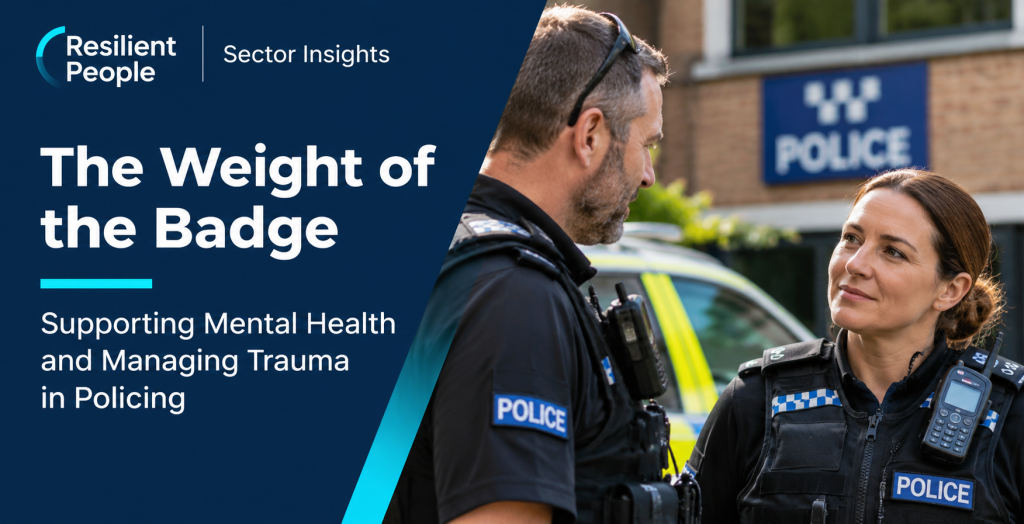
Why protecting those who protect others means preparing for the psychological demands of police work.
The Experiences We Carry
A fatal collision. A sudden death. A frightened child. A family receiving news that will change their lives.
For police officers and staff, encounters with some of life's most difficult moments are part of the job.
Sometimes they happen without warning. At other times, they build up through long investigations, repeated exposure to disturbing material or the responsibility of supporting people experiencing intense distress.
And then the next call comes in.
Policing demands professionalism, sound judgement, compassion and the ability to function under pressure. For many, it also brings a strong sense of purpose, pride and belonging.
But the ability to deal with difficult situations doesn't necessarily mean those experiences don’t affect us.
Some incidents stay with people. Others may seem manageable at the time but become more difficult to process later. And sometimes the greatest pressure comes not from a single event, but from the cumulative demands of the work.
Being prepared to face difficult things should not mean being expected to carry their impact alone.
The challenge for policing is not simply to develop resilient individuals, but to create working environments that recognise psychological risk, prepare people appropriately and provide effective support throughout their careers.
What the Numbers Tell Us
The 2026 National Police Workforce and Wellbeing Survey provides a revealing picture of the pressures facing police officers and staff in England and Wales.
Conducted on behalf of Oscar Kilo, the National Police Wellbeing Service, it received 55,602 responses from across 33 of the 43 territorial police forces in England and Wales.
Among respondents, 56% reported regularly feeling physically exhausted, while approximately 45% reported regularly feeling burnt out because of their work.
Almost two-thirds (63%) said they regularly worked beyond their normal hours, rising to 72% among police officers.
Yet the survey also revealed something important: many respondents continued to feel capable, committed and supported by their colleagues.
That contrast deserves attention.
People can be good at their jobs, committed to their colleagues and proud of their work while still experiencing considerable psychological strain.
As participation was voluntary and not every force took part, it’s best to treat these findings as indicative rather than a fully accurate picture. But nevertheless, they provide an important signal of the pressures experienced by a large number of police employees.
And while workload and fatigue affect many occupations, policing carries an additional challenge: repeated exposure to potentially traumatic experiences.
Trauma Is Not Always One Big Incident
When we think about trauma in policing, we often imagine a particularly serious incident.
A violent assault. A fatal road collision. A death in custody. A major investigation or an event involving serious injury or loss of life.
These experiences can have a significant psychological impact.
But trauma exposure in policing is not always confined to one defining event.
For a response officer, it may involve attending repeated incidents involving violence, suicide or sudden death.
For a detective, it may mean months investigating serious offences, interviewing victims or reviewing disturbing evidence.
For someone working in public protection or digital investigations, exposure may involve repeated contact with distressing accounts, images or recordings.
Control-room staff and others may also encounter deeply upsetting situations without being physically present at an incident.
These experiences differ, but they share an important characteristic: the psychological demands of policing can accumulate over time.
Research conducted by the University of Cambridge, supported by Police Care UK, provides valuable insight.
The Policing: The Job & The Life study analysed responses from 16,857 serving UK police officers and staff. Among the 12,534 trauma-exposed respondents with valid screening data, 7.5% met the screening criteria for PTSD and 11.9% for complex PTSD.
These findings suggest that approximately one in five trauma-exposed respondents had symptoms consistent with one of these conditions. And although these results should not be interpreted as a prevalence estimate for the entire police workforce, they do highlight the importance of recognising the potential psychological costs of police work.
Crucially, exposure to a potentially traumatic event does not mean somebody will inevitably develop PTSD. People respond differently, and many recover without developing lasting psychological difficulties.
The aim of good trauma support should therefore be neither to minimise people's experiences nor to assume that everyone exposed to difficult events will become unwell.
It should be to recognise risk, provide appropriate support and identify those who may need further help.
When Exposure Becomes Part of the Routine
One of the difficulties with repeated exposure is that experiences which would be extraordinary in most people's lives can become familiar within policing.
Officers and staff may develop ways of managing distressing situations, maintaining professional distance and concentrating on the task in front of them.
Those skills are often necessary.
But becoming accustomed to dealing with difficult events doesn't necessarily remove their potential impact.
And the effects may not always be obvious.
Someone might find themselves replaying an incident, becoming more irritable, sleeping poorly or struggling to switch off. Others may experience changes that are harder to recognise or attribute to work.
There is also a risk that cumulative exposure goes unnoticed because no single incident appears significant enough to trigger a formal support response.
This is particularly relevant in specialist investigative roles, where exposure may be frequent but less visible than attending a major incident.
Recent UK research into officers and staff investigating child sexual abuse material has highlighted the psychological demands associated with this work and the importance of workplace support.
It also reminds us that distressing exposure does not always result in PTSD. Depression, anxiety, emotional exhaustion and other difficulties may be more prominent for some individuals.
The absence of one major traumatic incident does not necessarily mean the absence of psychological risk.
That is why effective support needs to consider patterns of exposure, not simply individual events.
The Pressure Around the Incident Matters Too
Trauma exposure is an important occupational risk, but it doesn't explain the whole picture.
Research examining job quality and trauma-related symptoms among UK police personnel has identified associations between psychological wellbeing and working conditions, including workplace relationships, autonomy, work-life balance and the social environment.
This suggests that the circumstances surrounding demanding police work deserve attention alongside the incidents themselves.
Consider an officer attending a distressing incident towards the end of a long shift.
The incident may be unavoidable. But the opportunity to recover afterwards, the response of colleagues and supervisors, the demands of subsequent duties and the availability of appropriate support may all influence how manageable the experience becomes.
Likewise, an investigator repeatedly exposed to distressing material may benefit from supportive supervision, manageable workloads and opportunities to step away from particularly demanding tasks.
None of these measures can remove every psychological risk.
But they recognise that organisational conditions can either support or undermine people's ability to manage the demands of their work.
Further analysis of the 2026 National Police Workforce and Wellbeing Survey identified workload pressure as the strongest factor associated with poorer wellbeing. Importantly, that relationship remained evident even among people who felt highly engaged in their work or well supported by their managers.
It is a reminder that supportive leadership matters, but organisations must also address the conditions creating excessive pressure in the first place.
The psychological impact of policing comes from more than what officers and staff encounter. We must also think about the conditions in which they encounter it.
You Accepted the Queen's Shilling
There was a saying I remember from my time in the police:
“You accepted the Queen's shilling.”
It was a reminder that you'd chosen to join the police and, in doing so, accepted the responsibilities and difficult realities that came with the job.
There was a certain pride in that attitude.
Policing requires people who can remain composed under pressure, make difficult decisions and respond when others need help. Accepting those responsibilities is part of the commitment officers make.
But there is another side to that expectation.
When accepting the demands of the job becomes an expectation that people should simply tolerate whatever those demands do to them, it can make acknowledging difficulties feel like a failure.
An officer might be reluctant to admit that an incident has affected them. A detective may feel they should be accustomed to disturbing material. Someone struggling with exhaustion may worry about letting colleagues down.
And asking for help can become particularly difficult when people are concerned about how their colleagues or managers might respond.
Accepting the responsibilities of policing should not mean accepting psychological harm as an inevitable consequence.
Being professional doesn't mean being unaffected.
And resilience shouldn't mean never needing support.
Perhaps the most important change is recognising that seeking help is not a rejection of the commitment people made when they joined.
It's part of looking after themselves so they can continue fulfilling that commitment.
The Responsibility of Leadership
Having served as a police sergeant, I've seen how important the relationship between officers and their supervisors can be—not simply in maintaining operational standards, but in recognising when someone needs support.
Police managers carry significant operational responsibilities. They need to maintain standards, manage risk, support performance and make decisions that may have serious consequences.
But they are also in a position to notice when someone is struggling.
A colleague who becomes unusually withdrawn. Someone whose patience seems shorter than normal. An officer who appears exhausted or begins making uncharacteristic mistakes.
None of these changes automatically indicates a mental-health condition.
And supervisors should not be expected to become therapists.
But they can notice, ask questions, listen without making assumptions and help people access appropriate support.
They can also recognise when the problem may be connected to working conditions rather than an individual's ability to cope.
Sometimes that means considering workload, recovery time, exposure to difficult duties or the support available following an incident.
Sometimes it means having a conversation that an officer or member of staff might otherwise avoid.
Importantly, managers need support themselves. They cannot resolve every staffing difficulty, organisational pressure or psychological risk.
They need appropriate training, clear procedures, access to specialist advice and organisational backing.
Good leadership doesn't remove the difficult realities of policing. But it can make a considerable difference to how people experience and recover from them.
Preparing for Trauma, Not Simply Responding to It
One of the most encouraging developments in policing is the increasing recognition that psychological trauma should be treated as an occupational risk requiring systematic management.
The Police Covenant Annual Report 2025 identifies psychological risk management and trauma prevention as national priorities. It sets out proposals to expand psychological risk assessments and develop a more consistent national approach to trauma support.
This reflects a growing recognition that psychological hazards should be anticipated and managed, rather than addressed only after someone begins experiencing difficulties.
Rather than waiting until someone develops significant symptoms, forces can identify roles involving repeated exposure, consider the demands placed on individuals and put appropriate arrangements in place before difficulties arise.
That might involve role-specific preparation, supportive supervision, monitoring cumulative exposure, appropriate recovery opportunities and clear routes to additional support.
Following a potentially traumatic incident, employees may benefit from practical assistance, clear information, supportive contact and proportionate follow-up.
Peer-led approaches such as Trauma Risk Management (TRiM) can contribute by helping identify individuals who may require additional monitoring or support.
But TRiM is not a treatment for PTSD, and no single intervention should be regarded as a complete solution.
It is also important to distinguish practical operational debriefing from compulsory psychologically focused debriefing that requires people to recount or process traumatic experiences. NICE advises against psychologically focused debriefing for preventing or treating PTSD.
The content and purpose of a debrief matter more than its name. A practical discussion about an incident, operational learning or immediate welfare needs is not the same as requiring people to process their emotional responses.
For those experiencing persistent or worsening difficulties, timely access to appropriate clinical assessment and evidence-based treatment is essential.
The objective is not to treat everyone as psychologically injured.
It is to create a system that understands exposure, supports natural recovery and responds effectively when someone needs further help.
Supporting the People Behind the Service
Police officers and staff are expected to make difficult decisions, respond to emergencies, protect vulnerable people and support communities through some of their most challenging moments.
That responsibility carries psychological demands which cannot always be removed.
But accepting the realities of police work should not mean accepting avoidable harm.
We can prepare people for demanding roles. Recognise cumulative exposure. Support supervisors. Create environments where asking for help is safe. And provide effective, proportionate support following potentially traumatic experiences.
We can also recognise that resilience is not simply an individual characteristic.
It is influenced by the people, relationships, working conditions and organisational systems surrounding someone throughout their career.
Ultimately, supporting police wellbeing is not separate from maintaining a professional, capable and effective police service.
It is part of that responsibility.
When officers and staff are properly supported, they are better placed to sustain the judgement, compassion and professionalism that the public depends upon.
We cannot always protect police officers and staff from witnessing difficult things. But we can do more to protect their wellbeing before, during and after those experiences.
About the author
Barrie Penrose is Co-founder and Director of Resilient People and a former West Yorkshire Police sergeant, with experience in emergency response, serious investigations and operational leadership.
With an MSc in Positive Psychology with deeper interests in neuroscience and mindfulness, and expertise in workplace mental health and trauma, Barrie works with organisations to strengthen psychological safety, develop supportive leadership and prepare employees for psychologically demanding roles.
Further Reading and References
- Oscar Kilo (2026). National Police Workforce and Wellbeing Survey. National evidence on workload, fatigue, burnout and organisational support.
- Oscar Kilo (2026). National Wellbeing Survey Deep Dive. Further analysis of workload pressures and their relationship with wellbeing.
- University of Cambridge / Police Care UK. Policing: The Job & The Life. Research into trauma exposure, PTSD and complex PTSD.
- Police Care UK. Job Quality and PTSD in UK Policing. Analysis of workplace conditions and trauma-related symptoms.
- Research on child sexual abuse investigators. Protecting the Protectors. UK research into specialist investigative exposure and mental health.
- Home Office (2026). Police Covenant Annual Report 2025. National priorities relating to trauma prevention and psychological risk management.
- College of Policing. Wellbeing and Psychological Risk Guidance. Professional guidance on managing psychological risks.
- NICE. Post-Traumatic Stress Disorder: NG116. Evidence-based recommendations on PTSD prevention, assessment and treatment.
About Resilient People
At Resilient People, we help organisations create mentally healthy, psychologically safe workplaces through evidence-based training, consultancy and practical support.
We work with police and other emergency-service organisations to equip managers to recognise and respond to mental-health concerns, prepare employees for demanding roles and develop appropriate support following potentially traumatic workplace events.
Our programmes include Respond manager training, Mental Health First Aid, Trauma Prepared and Trauma Risk Management (TRiM).
Our aim is simple: helping organisations build Safer. Stronger. Prepared. workplaces.
23.11.2026
Police Mental Health and Trauma | The Weight of the Badge

19.10.2026
NHS Staff Mental Health and Wellbeing | Resilient People

29.09.2026
Looking After the People Who Keep Britain Moving