Looking After the People Who Keep Britain Moving
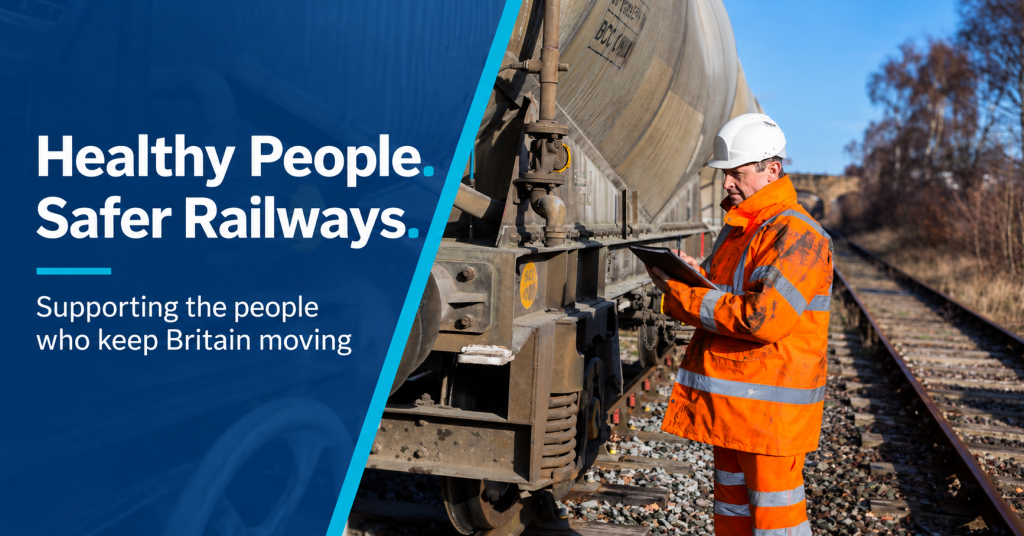
Why Mental Health and Wellbeing Matter Across the Rail Industry
Britain's railways are built around safety.
From signalling and engineering standards to competence, training and risk management, an enormous amount of work goes into ensuring millions of journeys can take place safely every year.
But even the most sophisticated railway ultimately depends upon people.
Drivers, conductors, station teams, engineers, control-room staff, maintenance teams, customer-service colleagues, managers and many others make thousands of decisions every day that keep the railway operating.
As Richard Hines, HM Chief Inspector of Railways, observed in the Office of Rail and Road's latest annual health and safety report:
“A healthy and safe railway is not created by systems alone. It is built every day through the judgement, decisions, and actions of those who design, operate, and maintain it.”
The report goes on to emphasise that systems matter, but their effectiveness ultimately depends on how they are delivered and embedded in everyday railway operations. Office of Rail and Road
That makes looking after the people who keep the railway moving more than simply a wellbeing initiative. It is part of creating a healthy, sustainable and effective railway.
Research from the Rail Safety and Standards Board (RSSB) shows why this deserves attention. Rail employees can experience a distinctive combination of shift work, challenging working conditions and, in some roles, exposure to potentially traumatic events. RSSB's Railway Mental Health Charter explicitly identifies these as reasons why mental health requires particular attention within the industry. RSSB
The experiences differ considerably from role to role, but the message is clear: workforce mental health deserves the same thoughtful, preventative approach that rail already applies to so many other areas of risk.
The Unique Demands of Rail
Rail is not one working environment.
Someone driving a train experiences very different demands from a station colleague, an engineer working overnight possessions, a signaller, a conductor dealing directly with passengers or a manager coordinating operations during disruption.
Yet there are characteristics of rail work that can place particular demands on wellbeing.
Shift and night working can affect sleep and recovery. Safety-critical roles bring significant responsibility. Disruption can create intense operational and customer pressure. Some employees work alone or away from colleagues, while public-facing teams can experience abuse and aggression.
Organisational change can add another layer of uncertainty.
And for some employees, there is the possibility of encountering serious incidents, fatalities, attempted suicides, assaults or other potentially traumatic events.
RSSB's current Railway Mental Health Charter recognises that rail organisations face different challenges and will be at different stages of maturity in managing mental health. Its response is not to prescribe a single initiative, but to encourage organisations to take a structured and evidence-based approach. RSSB
That distinction is important.
None of this means working in rail inevitably leads to poor mental health. Thousands of people build long, rewarding careers within the industry.
It does mean that understanding the particular pressures associated with the work is an important starting point for supporting the people doing it.
What Does the Research Tell Us?
One of the largest studies of mental health within the UK rail industry was conducted by RSSB in 2020, involving almost 4,000 employees.
The findings were significant.
43% of respondents met the criteria for a clinical mental health condition. Around 38% reported moderate-to-severe symptoms indicative of depression and 29% moderate-to-severe anxiety. Ten per cent reported symptoms consistent with clinical post-traumatic stress disorder or complex PTSD. RSSB
There is an important caveat.
The survey took place during the COVID-19 pandemic, when mental health deteriorated across the wider population too. RSSB explicitly notes this increase and also identifies methodological differences when making some comparisons with general-population data. We therefore shouldn't simply treat those figures as a measure of today's rail workforce. RSSB
But neither should we ignore what the research revealed about the working environment.
Of respondents who reported experiencing a traumatic event, almost three-quarters described at least some of those events as work-related. And despite the prevalence of mental-health difficulties identified by the study, only half of participants had sought help. RSSB
More recent RSSB work continues to describe mental ill health as a leading cause of sickness absence in rail and estimates a cost to the industry of at least £10.7 million a year. RSSB
So while we should be careful about treating a pandemic-era survey as a snapshot of today's workforce, the wider challenge has not disappeared.
And perhaps one of the most important findings remains this:
Providing support is only part of the challenge. Organisations also need to create environments in which people feel confident enough to use it.
When Pressure Becomes a Safety Issue
In a safety-critical industry, the relationship between health, wellbeing and performance deserves particular attention.
Fatigue can affect concentration and reaction times.
Excessive stress can make it harder to process information.
Poor sleep can influence attention and judgement.
And when people are overloaded or distracted, communication and decision-making can become more difficult.
This does not mean that someone experiencing a mental health problem is unsafe or incapable of performing their role. That would be inaccurate and risks reinforcing exactly the stigma organisations are trying to reduce.
The more useful question is whether organisations are identifying and managing work-related factors—such as fatigue, workload, insufficient recovery and sustained stress—that can affect people's health and their ability to work at their best.
This is where wellbeing and safety begin to overlap.
Rail has a long history of identifying hazards before they result in harm. Applying the same preventative mindset to psychological health makes sense.
Psychological health doesn't sit outside safety. Looking after the people who operate the system helps strengthen the system itself.
The Human Impact of Difficult Events
For some people working within rail, potentially traumatic events are an occupational reality.
Train drivers may experience fatalities or attempted suicides. Station and onboard teams can witness serious incidents or violence. Engineers and operational teams may respond to accidents, near misses or serious injuries.
And the impact is not necessarily limited to the person most directly involved.
Colleagues who attend an incident, provide assistance, manage the response or support others afterwards may also be affected.
RSSB's survey found that 41% of respondents had experienced a traumatic event, with 74% of those respondents describing at least some of their experiences as work-related. RSSB noted that the pattern of complex PTSD symptoms it identified was consistent with the potential impact of repeated exposure to traumatic events in trauma-exposed work. RSSB
But people respond to potentially traumatic experiences differently.
Many will recover naturally with appropriate support, and experiencing a potentially traumatic event does not mean someone will develop PTSD.
That distinction matters.
Good trauma support isn't about assuming that everyone involved in a difficult incident has been psychologically harmed. Nor is it about forcing people to talk about what happened immediately afterwards.
It is about creating a proportionate response: providing practical support, recognising individual differences, monitoring wellbeing and ensuring that people who continue to struggle can access appropriate help.
For organisations where serious incidents are foreseeable, planning that response before an incident happens can make an enormous difference.
Violence, Aggression and the Public-Facing Workforce
Not every psychological risk within rail comes from major incidents.
For some employees, a more regular challenge is dealing with aggression from members of the public.
Station teams, conductors, revenue staff and other public-facing colleagues may encounter verbal abuse, threats and occasionally physical assault.
Individual incidents matter, but so can their cumulative effect.
Repeatedly being shouted at, threatened or abused can begin to affect confidence, wellbeing and someone's sense of safety at work—even when no single incident appears particularly serious in isolation.
Interestingly, this isn't just a theoretical risk identified in sector guidance. One of the organisations participating in RSSB's recent Mental Wellbeing in Rail: Achieving Change project specifically identified exposure to verbal abuse, alongside bullying, workplace stress and mental-health-related sickness absence, among its workforce wellbeing issues. RSSB
This is another reason why organisations need to look beyond simply recording physical injuries.
Managers need to understand what their teams are experiencing and create opportunities for people to talk about difficult encounters before their effects accumulate.
Why People Don't Always Speak Up
RSSB's finding that only around half of participants had sought help raises an obvious question:
Why?
There probably isn't one answer.
Stigma remains a challenge across many workplaces. Some people may worry about being judged differently. Others may not want to burden colleagues or may have normalised feeling stressed or exhausted.
Within safety-critical environments, it is particularly important that organisations make processes around mental health, confidentiality and fitness for work clear so that uncertainty does not become another barrier to asking for support.
This makes trust incredibly important.
Employees need confidence that wellbeing conversations will be handled appropriately, that their privacy will be respected within appropriate boundaries and that asking for help does not automatically define them as incapable of doing their job.
Managers play an important role here.
They don't need to become counsellors or diagnose mental health problems. But they do need the confidence to notice changes, start a conversation, listen well and understand where further support is available.
Perhaps the simplest principle is this:
Support only works if people feel safe enough to use it.
Moving Beyond Wellbeing Initiatives
There is already considerable mental-health activity across rail.
RSSB's Railway Mental Health Charter provides an industry-specific framework for promoting, managing and supporting workforce mental wellbeing. Its Mental Wellbeing in Rail: Achieving Change project went a stage further, working with a train operator, freight operator and supplier between 2022 and 2024 to examine how organisations could implement, monitor and measure interventions in practice. RSSB
One of the clearest messages from that work is the importance of taking a structured approach.
RSSB describes six stages: engagement, assessment, formulation, planning, implementation and monitoring, and review. Participating organisations examined their own data, listened to employees, identified specific problems, agreed priorities and monitored what happened next. RSSB
That is quite different from simply assembling a collection of wellbeing initiatives.
Awareness days have a place.
Mental Health First Aiders and peer supporters can have a role.
Training can build knowledge and confidence.
But none should be expected to carry an organisation's mental-health strategy on its own.
RSSB's 2026 review of workplace peer support is particularly helpful here. It found that the research evidence is currently mixed and insufficient to conclude that peer support consistently improves workplace health outcomes. Importantly, RSSB doesn't conclude that peer support is ineffective; rather, it recommends integrating it within a wider strategy informed by organisational data, evidence-based interventions and ongoing monitoring. RSSB
This changes the question from:
“What wellbeing initiatives do we provide?”
to:
“How does our organisation manage and support psychological health?”
That is a much more powerful question.
Building Wellbeing Into the Way Rail Works
Creating a mentally healthy railway doesn't mean trying to remove every difficult aspect of the job.
Rail will always involve responsibility, disruption, demanding operational situations and work that sometimes takes place at unsociable hours.
But organisations can influence how those demands are managed.
Five principles stand out from the evidence.
Treat mental health as part of risk management. Look at working conditions and organisational factors that can contribute to poor wellbeing rather than relying solely on individuals to become more resilient.
Equip managers to have good conversations. Managers are often well placed to notice that something has changed. Give them the confidence and boundaries to respond appropriately.
Plan for difficult events before they happen. If exposure to potentially traumatic incidents is foreseeable, the organisational response should be planned too.
Take fatigue, workload and recovery seriously. These affect people's wellbeing and, in a safety-critical environment, can have wider implications for performance.
Measure what is actually working. Counting training sessions, champions or wellbeing campaigns tells us about activity—not necessarily impact. Listen to employees, use organisational data and be prepared to adapt.
RSSB's recent work provides an encouraging example of this approach. Its participating organisations used employee experience and company-specific data to identify their own priorities rather than assuming the same intervention would work everywhere. RSSB
None of these actions is particularly complicated in isolation.
The challenge—and opportunity—is making them part of everyday organisational practice.
Keeping People Moving
Britain's railways depend upon sophisticated infrastructure, technology, engineering and systems.
But every day, those systems ultimately depend upon people.
People make decisions.
People manage disruption.
People communicate risk.
People respond when something goes wrong.
And people support passengers and colleagues through difficult situations.
Looking after their mental health and wellbeing isn't an addition to running a safe and reliable railway. It is part of how a healthy, safe and sustainable railway is created.
By understanding the pressures different employees experience, equipping managers to respond, preparing for difficult incidents and creating cultures where people feel able to ask for support, rail organisations can protect the people at the heart of the industry.
Because when we support the people who keep Britain moving, we help keep the railway moving too.
Further Reading and References
For the website, I'd keep the references concise but link the titles to the primary sources:
Rail Safety and Standards Board (RSSB) — How is the Mental Health of Rail Employees?
RSSB — Railway Mental Health Charter
RSSB — Mental Wellbeing in Rail: Achieving Change
RSSB — Peer Support for Workplace Health and Wellbeing
Office of Rail and Road — Annual Report of Health and Safety on Britain's Railways 2025–26
About Resilient People
At Resilient People, we help organisations create mentally healthy, psychologically safe workplaces through evidence-based training, consultancy and practical support.
We have extensive experience working within the rail and transport sector, providing programmes including Mental Health First Aid, Respond manager training, Wellbeing Champions, Trauma Prepared and Trauma Risk Management (TRiM).
Our aim is simple: helping organisations build Safer. Stronger. Prepared. workplaces.
29.09.2026
Looking After the People Who Keep Britain Moving
14.09.2026
Building Safer Sites Starts with Supporting People

03.07.2026
Looking After Those Who Look After Our Communities: Supporting the Mental Health of Housing Professionals